
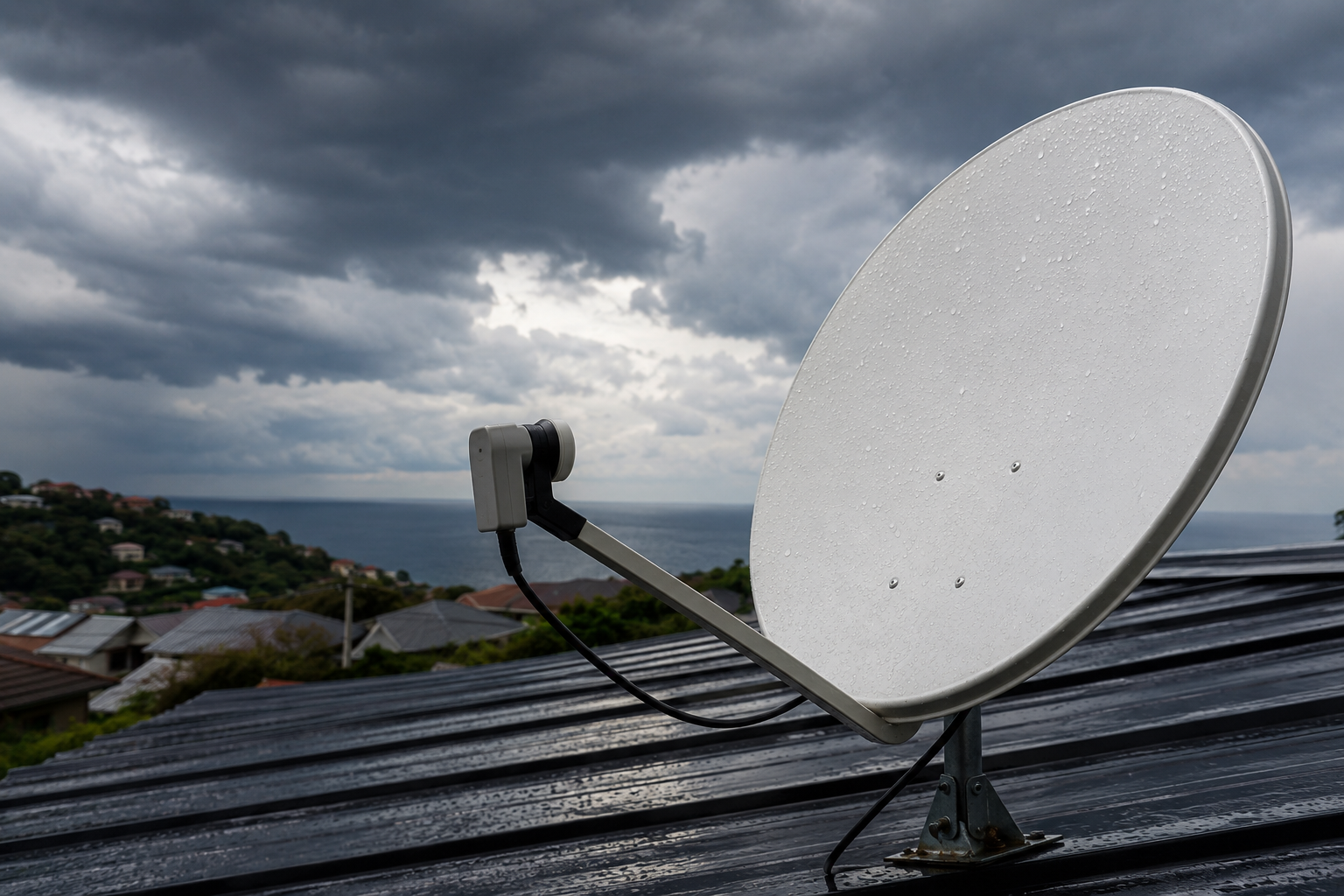
There are few things more frustrating than settling down to watch your favourite programme only to discover that your DStv signal has disappeared after a storm, heavy rain, or a windy day.
For many homeowners, the problem seems to appear out of nowhere. Everything worked perfectly before the weather changed, and now the decoder is displaying a signal error or certain channels are no longer available.
The good news is that weather-related DStv issues are usually caused by identifiable problems. In many cases, the rain or wind itself is not the actual cause. Instead, bad weather often exposes weaknesses that already existed within the installation.
Understanding what happens to a DStv system during storms and severe weather can help you determine whether the problem is temporary or whether professional repairs are needed.
Restore Your DStv Signal Quickly
Experiencing signal problems after wind or rain? Fill in the form below and get professional assistance from a qualified DStv technician.
How Weather Affects DStv Signals
DStv relies on satellite signals travelling thousands of kilometres between satellites in space and your satellite dish.
Unlike internet or cable television systems, satellite signals must travel through the atmosphere before reaching your equipment.
Because of this, severe weather can sometimes interfere with signal quality.
However, there is an important distinction to understand.
Temporary weather interference and installation-related problems are not the same thing.
A properly installed DStv system can usually handle normal weather conditions very well. When signal problems become severe or continue after the weather has cleared, there is often an underlying issue that requires attention.
What Is Rain Fade?
One of the most common causes of temporary signal loss during heavy rain is a phenomenon known as rain fade.
Rain fade occurs when dense rainfall weakens the satellite signal before it reaches the dish.
During extremely heavy downpours, the signal may become weaker than the decoder can process, causing channels to freeze, pixelate, or disappear completely.
In many cases, the signal returns once the rainfall decreases.
This type of interruption is generally temporary and does not indicate that anything is broken.
However, if signal problems continue long after the rain has stopped, there may be another issue affecting the system.
Why Wind Often Causes Bigger Problems Than Rain
While heavy rain can temporarily weaken signal strength, strong wind often causes more lasting issues.
This is because wind can physically move parts of the installation.
Satellite dishes need to be aligned with incredible accuracy. Even a small shift can significantly reduce signal quality.
Many homeowners are surprised to learn that a dish can move by only a few millimetres and still experience major signal problems.
After strong winds, the dish may no longer be pointing at the exact position required to receive the strongest signal.
This is one of the most common reasons people experience DStv no signal errors after windy weather.
Dish Misalignment After Storms
Dish alignment issues are among the most frequent causes of signal problems following storms.
The mounting bracket that holds the dish in position is designed to withstand normal weather conditions. However, over time, bolts can loosen and components can wear.
When strong winds place pressure on the dish, even slightly weakened brackets may allow movement.
The result is reduced signal quality, intermittent channel loss, or complete signal failure.
In some cases, the movement is so small that it cannot be seen with the naked eye. Yet the signal loss can be significant.
This is why many homeowners assume the weather damaged the decoder when the real issue is simply dish alignment.
Water Entering Cable Connections
Rain can expose another common problem: poorly sealed cable connections.
Outdoor cable joints and connectors should be protected from moisture.
When seals deteriorate or connectors become damaged, water can enter the connection and interfere with signal transmission.
The effects are often unpredictable.
Some channels may disappear while others continue working. Signal quality may fluctuate throughout the day. The problem may even seem to improve temporarily before returning.
Moisture-related faults are particularly common in older installations where connectors have been exposed to years of weather.
If left unresolved, corrosion can develop and permanently damage the connection.
Damaged or Ageing LNB Components
The LNB is the small device attached to the front of the satellite dish.
Its job is to collect the satellite signal and send it through the cables to the decoder.
Like any outdoor component, the LNB is constantly exposed to sunlight, rain, wind, and temperature changes.
Over time, this exposure can cause deterioration.
A failing LNB may continue functioning under normal conditions but struggle during bad weather.
This is why some homeowners only notice problems during rain or storms.
The weather is not necessarily causing the failure. It is revealing an existing weakness in the equipment.
As the LNB continues to age, signal problems often become more frequent.
Tree Movement and New Obstructions
Weather can also affect objects surrounding the dish.
Strong wind may cause branches to move into the signal path.
Trees that have grown over time can begin obstructing the dish without homeowners noticing.
Even temporary obstructions caused by storm-damaged branches can interfere with signal reception.
Because satellite signals require a clear line of sight, anything that blocks the path between the dish and the satellite can affect performance.
Sometimes the solution is as simple as trimming vegetation that has gradually become a problem.
Weak Mounting Structures
Not all signal problems are caused by the dish itself.
The structure supporting the dish also plays an important role.
A mounting pole, wall bracket, or roof installation that was not secured properly may become unstable during bad weather.
This instability allows the dish to move, resulting in reduced signal quality.
In severe cases, the entire installation may require reinforcement or replacement.
Homeowners often focus on the dish while overlooking the condition of the supporting hardware.
A professional inspection usually includes checking the stability of the entire mounting system.
Need a Signal Inspection?
A professional signal test can quickly determine whether your dish has moved out of alignment after a storm.
Why Some Channels Disappear While Others Continue Working
One of the most confusing weather-related symptoms is when some channels continue working while others disappear.
This occurs because different groups of channels use different signal frequencies.
When signal quality begins to drop, certain frequencies are affected before others.
As a result, sports channels, movie channels, or HD channels may disappear first while other channels remain available.
This often leads homeowners to believe there is a subscription issue when the real problem is signal quality.
Understanding this behaviour helps explain why partial signal loss is so common after severe weather.
Why HD Channels Are Usually Affected First
High-definition channels typically require stronger signal quality than standard-definition channels.
When signal strength starts to decline, HD channels often show the first warning signs.
You may notice:
- Pixelation on HD channels
- Intermittent freezing
- Sound interruptions
- Complete channel loss
Meanwhile, standard-definition channels may continue working normally.
This is often one of the earliest indicators that the installation needs attention.
Common Mistakes Homeowners Make After Storms
Many homeowners immediately begin resetting the decoder repeatedly.
While restarting the decoder can occasionally resolve minor software issues, it will not fix physical signal problems.
Another common mistake is attempting to adjust the dish without proper equipment.
Because satellite alignment requires precision, small adjustments often make the problem worse.
Some homeowners also assume that the decoder itself has failed and consider replacing it before properly diagnosing the issue.
In reality, weather-related signal problems are far more likely to involve the dish, LNB, cables, or mounting hardware than the decoder itself.
How to Tell Whether the Problem Is Temporary
Not every weather-related signal interruption requires repairs.
If the signal disappears during extremely heavy rain but returns shortly after conditions improve, the issue may simply be rain fade.
However, there are several warning signs that suggest a more serious problem:
- Signal remains weak after the weather clears
- Missing channels continue for several days
- Signal quality fluctuates constantly
- Pixelation becomes more frequent
- Windy conditions repeatedly cause signal loss
These symptoms often indicate an installation issue rather than temporary weather interference.
When Should You Call a Technician?
If your signal has not returned after the weather has improved, it is usually worth arranging an inspection.
A technician can test signal strength, inspect dish alignment, evaluate the LNB, examine cable connections, and identify faults that are difficult to detect without specialised equipment.
Professional diagnosis often saves time and prevents unnecessary replacement of working equipment.
Instead of guessing which component is causing the problem, the issue can be identified accurately and repaired correctly.
Final Thoughts
Bad weather does not always cause DStv problems directly. More often, it exposes weaknesses that were already present within the installation.
A slightly misaligned dish, ageing LNB, damaged connector, or unstable mounting bracket may work adequately during normal conditions but fail when challenged by heavy rain or strong wind.
Understanding the difference between temporary weather interference and genuine installation faults is the first step toward solving the problem properly.
The sooner the underlying issue is identified, the easier it is to restore reliable signal performance and prevent future disruptions.
Get Your DStv Signal Back
If your signal problems started after a storm, fill in the form below and let a technician identify the exact cause.